

How to Call Someone Abroad Who Only Has a Landline (No WhatsApp, No Smartphone)

WhatsApp solved international calling for everyone whose family owns a smartphone. But millions of parents and grandparents still live on a landline — no apps, no data plan, sometimes no mobile at all. If that describes someone you love, "just use WhatsApp" is useless advice: app-to-app calling only works when both sides run the same app. This guide covers what actually works when the other end is a plain telephone, ranked honestly by cost and hassle.
Why the Free Apps Can't Do This
WhatsApp, Viber, FaceTime, Telegram — all of them route calls over the internet between two installed apps. A landline has no internet and no app, so there is nothing for the call to land on. (Viber does sell a separate paid product for real numbers, and we compare that world in WhatsApp vs real international calls.) To ring a physical telephone in another country, the call must, at some point, enter the old-fashioned phone network — and someone has to pay that network's per-minute termination fee. The whole game is paying that fee once, at wholesale, instead of at your carrier's retail markup.
Your Real Options, Ranked
1. Browser or app-based per-minute calling — the default choice
Services like BoraPhone exist for exactly this job: they take a call from your internet connection and terminate it onto the foreign phone network at close-to-wholesale rates — typically $0.02–0.10 per minute depending on the country, shown before you dial. On BoraPhone specifically, everything runs in a browser tab: sign up with an email, dial your parents' landline with the country code, talk. No installs on either end. First call free, no subscription, 100% refund if a call fails.
The one honest limitation: you pay per minute (rounded up to the next minute), so it is not "unlimited." For an hour-long Sunday call to a $0.03/min landline, that is about $1.80 — most families find that ends the discussion.
2. Carrier international add-ons — convenient, rarely cheap
US and European carriers sell monthly international packages ($5–15/month) that reduce their default $1–3/min rates to something tolerable for a fixed list of countries. They make sense if you only ever call one country and want dialing straight from your phone app with zero setup. They stop making sense the moment your calls are irregular — you pay the fee in months you barely call — or your country's rate is still high inside the package. Do the math against per-minute pricing once; the cost comparison here walks through it.
3. Calling cards — the old standby, now mostly a fee machine
Prepaid calling cards still exist, and their advertised per-minute prices look competitive. The fine print is where they win their money back: connection fees per call, "maintenance" fees per week, rounding to 3-minute increments, and credit that expires. If a card is the only option (for example, calling from a landline with no internet in the house), buy small denominations and read the fee table first — or read our audit of hidden fees in cheap calling services before you do.
4. Ask the relatives to switch — the long game
Sometimes the sustainable fix is on the other end: a simple smartphone plus a family member who sets up WhatsApp. Be realistic, though — for many elderly relatives the landline is not a technology gap but a preference, and a phone that rings on the wall beats an app that needs charging, updates, and reading glasses. Meet people where they are; the phone network still works beautifully.
One Cost Trick: Call the Landline, Not the Mobile
If your family has both a fixed line and a mobile, check both rates before dialing — in many countries, calling the landline costs roughly half as much as the mobile, because mobile networks charge higher termination fees. India, much of Europe, and large parts of Africa show a real spread; the US and Canada barely differ. The rate calculator shows both numbers for every country, and we explain the mechanics in landline vs mobile rates abroad.
Set It Up Once: the Weekly Call Home
Here is the whole system, ten minutes one time:
- Create the account at boraphone.com with your email — no phone number needed on your side either.
- Save the landline in full international format — e.g. +91 11 2345 6789 for a Delhi fixed line, +234 1 234 5678 for Lagos. Country pages like India and Nigeria list formats and current rates.
- Make the first call free and check the line quality at the hour you usually call.
- Top up $5–10. At landline rates, $10 is typically several months of weekly calls.
- Optional but kind: set a fixed weekly time. A landline cannot see missed calls from an app — predictability is the feature your relatives actually want.
The apps changed who can call for free. They did not change who your family is. For everyone whose mother still answers the same telephone she has had for thirty years, per-minute calling to real numbers is not legacy technology — it is the bridge that still works.

Written by
Serpius DentoSerpius works with communication and customer relations at BoraPhone. With hands-on experience helping users navigate international calling, he writes practical guides based on real conversations with customers worldwide.
Recent Posts
5 Minute Free Call: Where to Actually Get Free Minutes in 2026
Looking for a 5 minute free call online? Here is every service that gives you free calling minutes, how many you really get, and how to make a short free call to any country right now.
How to Call a Phone from Google: Every Option Explained
Can you call a phone number from Google? Yes, several ways: Google Voice, Google Meet, Assistant, and search. Here is how each works, what it costs, and what to use instead when Google says no.
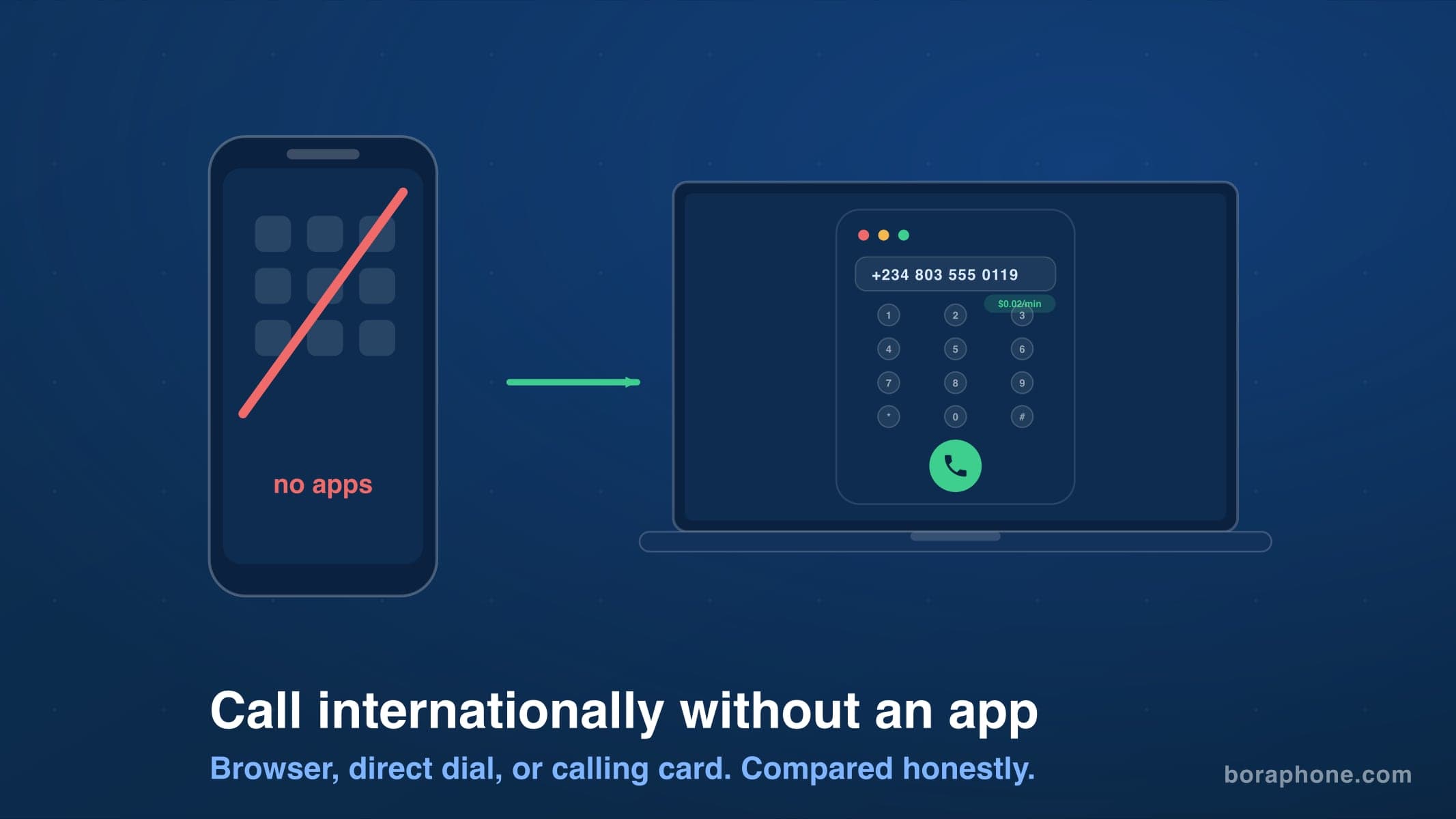
How to Call Internationally Without an App (2026 Guide)
You do not need to download anything to call another country. Browser calling, direct dialing, calling cards, and roaming-free options compared, with real costs for each.