

VoIP vs. Traditional Carrier for International Calls: A Cost Comparison with Real Numbers

If you make international calls through your mobile carrier, you are almost certainly overpaying. Based on our rate monitoring across major US carriers and VoIP providers, switching to a VoIP service saves between 80% and 95% on every call. That is not a rounding error. On a 20-minute call to India, the difference can be $25 or more. Below, we break down the real numbers so you can see exactly what you are paying and what you could be paying instead. For detailed per-country data, see our international calling rates report for 2026.
The Comparison Table
We've analyzed current per-minute rates from AT&T, Verizon, and T-Mobile for standard international calls (without add-on plans) and compared them to BoraPhone's VoIP rates.
| Destination | AT&T | Verizon | T-Mobile | BoraPhone | Savings |
|---|---|---|---|---|---|
| United Kingdom | $1.00/min | $1.29/min | $1.00/min | $0.02/min | 98% |
| India | $1.50/min | $1.49/min | $1.25/min | $0.03/min | 98% |
| Mexico | $1.00/min | $0.99/min | $1.00/min | $0.04/min | 96% |
| Philippines | $2.00/min | $1.79/min | $2.00/min | $0.08/min | 96% |
| Nigeria | $2.50/min | $2.49/min | $2.50/min | $0.10/min | 96% |
| Australia | $1.00/min | $1.29/min | $1.00/min | $0.03/min | 97% |
| Germany | $1.00/min | $1.29/min | $1.00/min | $0.02/min | 98% |
| Japan | $1.50/min | $1.49/min | $1.25/min | $0.05/min | 97% |
| Brazil | $2.00/min | $1.99/min | $2.00/min | $0.07/min | 97% |
Rates are for calls to landlines. Mobile rates may be slightly higher. Carrier rates reflect standard pay-per-use pricing without international calling add-ons. Data collected March 2026.
The pattern is clear. Carriers charge $1.00 to $2.50 per minute. VoIP rates for the same destinations sit between $0.02 and $0.10 per minute. The savings are not marginal. They are a full order of magnitude.
Why Carriers Charge So Much
Traditional carriers built their international calling infrastructure decades ago. Those legacy networks require physical switching equipment, bilateral agreements with foreign telecom operators, and ongoing maintenance of aging hardware. Every call passes through multiple intermediaries, and each one takes a cut. On top of infrastructure costs, carriers apply significant markup because international calling is considered a premium service. Most customers do not check the rates before dialing, which means carriers have little incentive to lower prices.
Carrier international calling add-on plans can reduce these rates, but they come with monthly fees ($5 to $15) and still charge more per minute than VoIP alternatives. They also lock you into a specific carrier ecosystem.
How VoIP Keeps Rates Low
VoIP (Voice over Internet Protocol) routes calls over the internet instead of through traditional telephone switching networks. This eliminates most of the intermediary fees that inflate carrier pricing. Modern audio codecs compress voice data efficiently, so calls require minimal bandwidth. There is no legacy infrastructure to maintain, no physical switches to operate, and no bilateral settlement fees to pay on most routes.
Browser-based services like BoraPhone take this a step further by removing the need for a dedicated app. You open your browser, enter the number, and call. The technical overhead is minimal, and those savings get passed directly to the caller. You can read more about how these services compare in our guide to the best Skype alternatives for international calls in 2026.
Beyond Price: What Else Matters
Cost is the biggest differentiator, but it is not the only one. Here is how VoIP and carriers compare on other factors.
Call quality. Modern VoIP services use HD voice codecs that often sound better than a standard carrier connection. As long as you have a stable internet connection with at least 1 Mbps upload speed, call quality is excellent. Carrier calls can degrade too, especially on congested cell towers.
Reliability. Carriers have a slight edge in areas with poor internet but strong cellular coverage. However, in any location with reasonable WiFi or 4G/5G data, VoIP reliability matches or exceeds carrier performance.
Features. VoIP platforms typically offer caller ID, call recording, contact management, and detailed call history. Most carrier international calling plans offer none of these extras.
Ease of use. Browser-based VoIP services require zero setup. No app to download, no account activation with your carrier, no calling card PINs to remember. You sign up, add credit, and start calling.
When a Traditional Carrier Still Makes Sense
There are two situations where using your carrier is the better choice. First, emergency calls. If you need to reach emergency services in a foreign country, always use your phone's native dialer. VoIP services are not designed for emergency calls and may not route to local emergency numbers correctly.
Second, when you have no internet access at all. If you are in a location with cellular signal but no WiFi and no mobile data, your carrier is the only option. This is increasingly rare as data coverage expands globally, but it still applies in very remote areas.
For everything else, VoIP is the better choice. If you want to learn the full process, our complete guide to making international calls walks through every step.
How to Switch to VoIP in 3 Steps
Making the switch takes less than two minutes.
- Go to BoraPhone.com. Open any browser on your phone, tablet, or computer. No app download required.
- Create an account and add credit. You can start with as little as $5. At VoIP rates, that gives you hours of calling time to most countries.
- Enter the number and call. Dial using the international format (+country code + number) and connect instantly.
That is it. No contracts, no monthly fees, no carrier plan changes. You can also keep using your carrier for domestic calls and switch to VoIP only for international ones. Many of our users do exactly that. For a completely free option to test the service, check out our guide on how to make free international calls in 2026.
FAQ
Is VoIP call quality as good as a regular phone call?
Yes, and often better. Modern VoIP services use wideband audio codecs that capture a fuller range of voice frequencies than traditional phone lines. The only requirement is a stable internet connection. On WiFi or a solid 4G/5G connection, most people cannot tell the difference between a VoIP call and a carrier call.
Do I need to cancel my phone plan to use VoIP?
No. VoIP works alongside your existing phone plan. You keep your carrier for domestic calls, texts, and data, and use a VoIP service like BoraPhone whenever you need to make an international call. There is no conflict between the two.
Are there hidden fees with VoIP services?
Reputable VoIP services like BoraPhone have transparent, pay-as-you-go pricing. You see the per-minute rate before you dial, and you are charged only for the minutes you use. There are no connection fees, no monthly subscriptions, and no expiration on your credit. BoraPhone also offers a 100% refund on any call that fails to connect.

Written by
Serpius DentoSerpius works with communication and customer relations at BoraPhone. With hands-on experience helping users navigate international calling, he writes practical guides based on real conversations with customers worldwide.
Recent Posts
5 Minute Free Call: Where to Actually Get Free Minutes in 2026
Looking for a 5 minute free call online? Here is every service that gives you free calling minutes, how many you really get, and how to make a short free call to any country right now.
How to Call a Phone from Google: Every Option Explained
Can you call a phone number from Google? Yes, several ways: Google Voice, Google Meet, Assistant, and search. Here is how each works, what it costs, and what to use instead when Google says no.
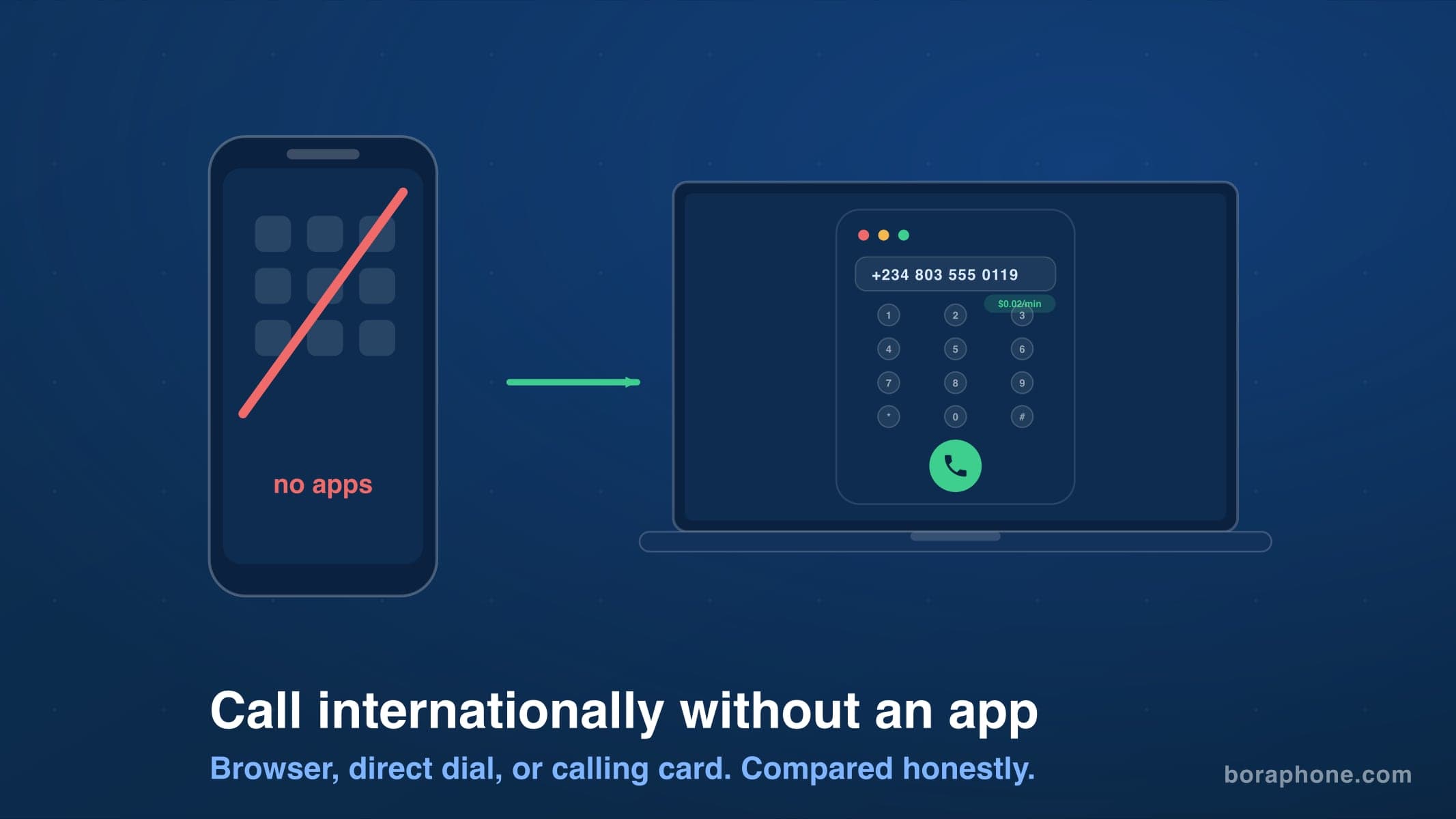
How to Call Internationally Without an App (2026 Guide)
You do not need to download anything to call another country. Browser calling, direct dialing, calling cards, and roaming-free options compared, with real costs for each.