

VoIP Rate Comparison 2026: What Providers Actually Charge Per Minute

Every VoIP provider advertises a "from" price. Almost none of them charge it for the country you actually call.
We compared how international VoIP tariffs are actually structured in 2026, across browser services, calling apps and calling cards, and found spreads of 5x to 10x between providers on the exact same destination. Not on obscure routes. On Nigeria, the Philippines, India: the corridors most people call.
This is a guide to comparing VoIP rates properly, with the specific traps that make headline numbers meaningless.
Why "from $0.01/min" tells you almost nothing
That advertised floor rate is real. It just applies to the cheapest destination on the provider's entire price list, usually a landline in the US, Canada, or western Europe. Those routes are cheap for everybody because termination costs there are near zero.
The destinations people actually pay for, mobile numbers in South Asia, Africa and Latin America, are priced on a completely different scale. A provider can honestly advertise "from $0.01/min" while charging $0.13/min to a Nigerian mobile.
A worked example. Yolla publicly lists Nigeria at $0.129/min to mobile and $0.15/min to landline. Our own live Nigeria rates sit in the low single-digit cents for the same destination. Same call, same networks on the far end, materially different price. Neither provider is lying. They are quoting different things, and only one of those numbers appears in the marketing.
The rule: never compare providers on their headline rate. Compare them on the rate to the one destination you call most.
The four numbers that determine what you actually pay
A VoIP tariff is not a single number. Four things multiply together into your real cost per call.
1. The mobile rate, not the landline rate
In most of the world outside North America and Europe, the person you are calling is on a mobile. Mobile termination fees are higher than landline fees everywhere, and providers pass that straight through, often at 2x to 4x the landline rate for the same country.
Providers know their landline rate looks better. That is the one that ends up on the pricing page. When you compare, find the mobile column.
2. Billing increments
Per-second billing charges you for 61 seconds when you talk for 61 seconds. Per-minute rounding charges you for 2 minutes. Some calling cards still use 3-minute increments, which turns a 61-second call into a 3-minute charge, nearly triple.
On short calls, the increment matters more than the rate. A provider at $0.03/min with per-second billing beats one at $0.02/min with 3-minute rounding on every call under three minutes.
3. Connection and top-up fees
A per-call connection fee is a flat charge added regardless of duration, and it destroys the economics of short calls. A $0.20 connection fee on a two-minute call to India at $0.02/min means you paid $0.24 for $0.04 of talk time, a 500% markup that never appears in the rate comparison.
Top-up fees do the same thing at the account level. Some providers charge roughly a dollar to add credit; app-store payment processing can add another cut on top.
4. Credit expiry
Credit that expires after a period of inactivity raises your effective rate on everything you did manage to spend. If you top up $10, use $6, and lose the rest to a 90-day expiry clause, you paid a 67% premium on every minute you actually used.
We covered all four of these in depth, provider by provider, in the real cost of "cheap" calling apps.
How VoIP tariff models compare
Providers cluster into four pricing models, and the right one depends entirely on your calling pattern.
| Model | Typical structure | Cheapest when | Watch out for |
|---|---|---|---|
| Pay-as-you-go browser VoIP | Per-minute, no subscription, credit-based | You call irregularly or to many countries | Credit expiry policies; minimum top-up sizes |
| Subscription / unlimited plans | Flat monthly fee to a country set | You call one destination heavily and predictably | Landline-only coverage; auto-renewal; "fair use" caps |
| Calling apps with per-country bundles | Prepaid minute packs per destination | You call one country regularly | Bundles expiring monthly; unused minutes lost |
| Calling cards | Prepaid balance, access numbers | Rarely cheapest in 2026 | 3-minute rounding, maintenance fees, expiry |
The dividing line is volume to a single destination. If you make several hours of calls a month to one country with landline coverage, a subscription can beat per-minute pricing. For everyone else, meaning occasional calls, multiple countries and mostly mobile numbers, per-minute pay-as-you-go wins, because you are not paying for capacity you do not use.
How to compare two providers in five minutes
- Pick your real destination. Not "international", but the specific country, and whether it is a mobile or landline.
- Find that exact rate on both providers. If a provider makes you sign up before showing the rate, treat that as a signal.
- Check the billing increment. Search the terms page for "increment", "rounding", or "per second".
- Search for "connection fee". Silence is not a no; check the FAQ and the terms separately.
- Search for "expire", "inactivity", or "validity" in the terms to find credit expiry.
- Multiply it out for a real call. Take a typical call length and compute the actual cost including fees. This is the only number that matters.
Most providers survive steps 1 and 2 and fail somewhere in 3 through 5. That is where the 5x spreads come from.
Where BoraPhone sits
We price per-minute with no subscription, and the rate for the number you are dialing appears before the call connects, so there is nothing to look up in a tariff table. There is no connection fee, and your first call is free so you can test quality before spending anything.
Rates vary by destination, so check the live rate calculator or a specific country page like India, the Philippines, or Pakistan for exact current pricing. For a broader per-country breakdown against carrier rates, see our international calling rates report.
We are not the cheapest possible option for every corridor on earth, and any provider claiming that is quoting its floor rate. We are transparent about which number applies to your call before you make it, which is the part most of this industry is built on obscuring.
FAQ
Which VoIP provider has the cheapest international rates?
It depends entirely on the destination. No provider is cheapest everywhere. Rate tables are built from wholesale termination costs that differ per country and per network, so a provider that is cheapest to India may be among the most expensive to Nigeria. Compare on the one country you call most, using the mobile rate.
Why is calling a mobile more expensive than a landline?
Mobile networks charge higher termination fees to receive an incoming call than fixed-line operators do, and every provider passes that cost through. In countries where most people use mobiles, which is most of South Asia, Africa and Latin America, the mobile rate is the only one that matters for comparison.
Are VoIP rates cheaper than carrier international plans?
Almost always, and usually by one to two orders of magnitude. US carriers charge roughly $1 to $3.50 per minute for pay-per-use international calls, against a few cents per minute on VoIP. The exception is destinations bundled into your existing plan. Mexico and Canada are commonly included in US unlimited plans, and if yours includes them, that is free.
How do I compare VoIP tariffs fairly?
Use the same destination, the same number type (mobile or landline), and a realistic call length, then add connection fees and billing rounding before comparing. Headline "from" rates are not comparable across providers because each one quotes its own cheapest route.
Want to see the rate before you dial? Try BoraPhone : per-minute pricing shown up front, no app, first call free.

Written by
Serpius DentoSerpius works with communication and customer relations at BoraPhone. With hands-on experience helping users navigate international calling, he writes practical guides based on real conversations with customers worldwide.
Recent Posts
5 Minute Free Call: Where to Actually Get Free Minutes in 2026
Looking for a 5 minute free call online? Here is every service that gives you free calling minutes, how many you really get, and how to make a short free call to any country right now.
How to Call a Phone from Google: Every Option Explained
Can you call a phone number from Google? Yes, several ways: Google Voice, Google Meet, Assistant, and search. Here is how each works, what it costs, and what to use instead when Google says no.
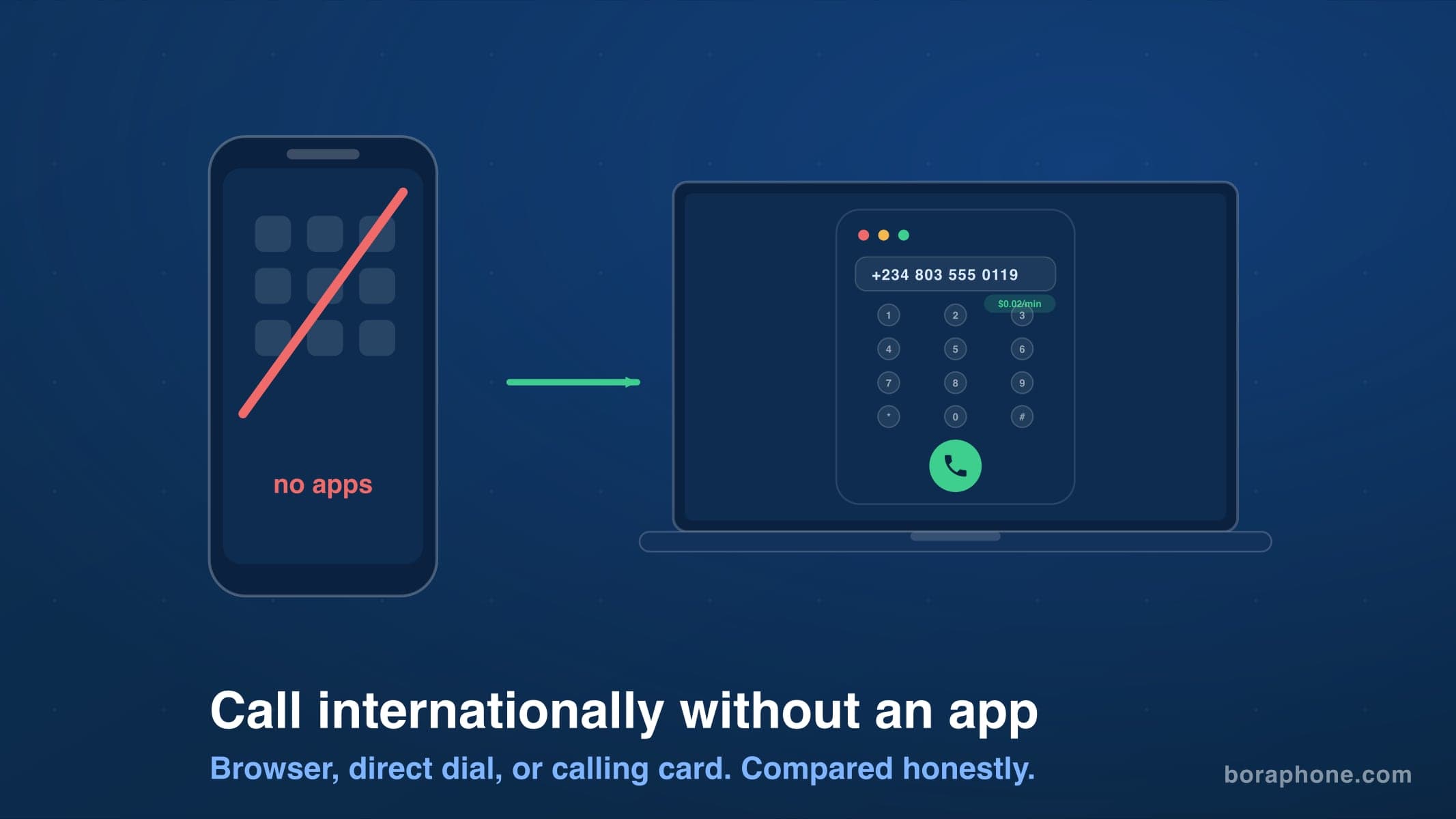
How to Call Internationally Without an App (2026 Guide)
You do not need to download anything to call another country. Browser calling, direct dialing, calling cards, and roaming-free options compared, with real costs for each.